Eporner HD Sex Porn Discounts Sex Games Porn Games XXX Games Hentai Games PornStar Games 3D Porn Celebrity Sex Videos Free Porn Games
Live Sex Free Live Sex Free Sex Games Páginas Porno Nude Celebrities TikTok Porn Sex Cam Rose Toy Cams Porno AI Porn Videos
Live Sex Free Live Sex Free Sex Games Páginas Porno Nude Celebrities TikTok Porn Sex Cam Rose Toy Cams Porno AI Porn Videos

Published on 2026/04/02


MICHAL FALLEN 2026
If you've got nothing better to do —and if you're reading this, let's be honest, you probably don't— I've got a plan for you. Let's take a look together at some of the latest photos photographer Michal Fallen has shared since the last time we featured him here. 


FEATURED MODEL
ONLYFANS · FREE
Cocoa Hazel Fantasies
@ebo_goddessvip
Discover her photos, explore her content and visit her profile for free.

FEATURED MODEL
ONLYFANS · FREE
Sarah Hart
@sexyblondesarah
Discover her photos, explore her content and visit her profile for free.





 vk.com/miofallen
ExtraBall
Singer Tokischa takes off her panties in the middle of a performance and threw them to someone in the audience.
ExtraBall2


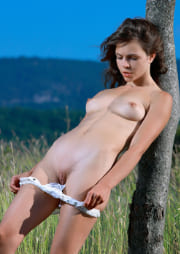





AMATEUR FLESH: HONEYMELON
Our featured girl today seems to know exactly what her strongest asset is. And we're certainly not going to be the ones to disagree with her.
She doesn't need elaborate sets or particularly fancy productions. A phone, a mirror, her bedroom, and two very convincing reasons to get our attention are more than enough.
Because one look through her gallery makes it pretty clear that she knows exactly what her best features are and, more importantly, she knows how to put them front and center.
Selfies, mirrors, spontaneous poses, and that special charm amateur photos have when they seem more interested in turning people on than winning a photography award.
And hey, mission accomplished.

# See photos and videos
ExtraBall







MARIO BROS. MORE THAN 40 YEARS OF JUMPING
The story of Mario begins in 1981, when Nintendo released Donkey Kong, an arcade game designed by Shigeru Miyamoto in which a small character had to dodge obstacles and jump over barrels to rescue a woman kidnapped by a giant gorilla.

Back then, he wasn't even called Mario. He was simply known as Jumpman, and much of his appearance was born out of the huge graphical limitations of the time. With so few pixels available, Miyamoto had to come up with simple solutions to make that tiny character instantly recognizable.
The cap meant they didn't have to properly draw and animate his hair. The mustache helped separate his nose from the rest of his face without having to draw a detailed mouth, while the overalls made it easier to visually distinguish his arms from his body when the character moved.
What we instantly recognize today as Mario was, to a large extent, a collection of practical solutions to technical problems.
The name came shortly afterward. Nintendo of America began calling the character Mario after Mario Segale, the landlord of the warehouse the company rented in the United States.
In 1983 came Mario Bros., where he shared the spotlight with his brother Luigi and his profession as a plumber was firmly established. But the real leap forward came two years later.
In 1985, Nintendo released Super Mario Bros. for the Famicom and Nintendo Entertainment System. Mario began running through huge levels, traveling through pipes, hitting blocks, collecting coins and facing Bowser to rescue Princess Peach.
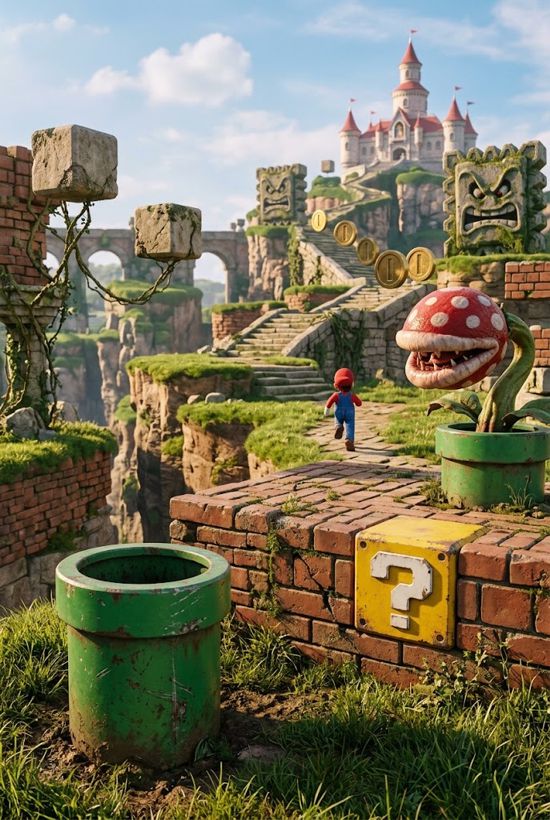
The game went on to become one of the most important and influential titles in video game history, selling more than 40 million copies.
From there came Super Mario Bros. 2, Super Mario Bros. 3, Super Mario World, Super Mario 64, Super Mario Sunshine, Super Mario Galaxy, Super Mario Odyssey and dozens more. Mario also started racing karts, playing tennis, golf and soccer, competing in the Olympic Games, throwing parties and taking on pretty much every profession Nintendo could imagine.
Over the decades, the Mario franchise has sold hundreds of millions of video games, and its universe has expanded far beyond consoles.
TV shows, toys, clothing, comics, merchandise, theme parks and movies have turned the character into one of the biggest icons in global pop culture.
His image has become so recognizable that you don't even need to have played one of his games to know who he is. A red cap, a mustache, blue overalls and an M are enough.
More than four decades after his first appearance, Mario belongs to that small group of characters that have managed to escape the medium they were originally created for. The internet has adopted him, transformed him, parodied him and reimagined him in pretty much every possible way.
And to think it all started with a handful of pixels jumping over barrels.
# Watch video
ExtraBall








 CamBB.xxx
We find the best live porn cams across many different cam sites like Streamate, Chaturbate, Cam4 and Stripchat.
 ChatSex.xxx
With Chat Sex you get free sex cams featuring nude cam girls you can chat with for free.
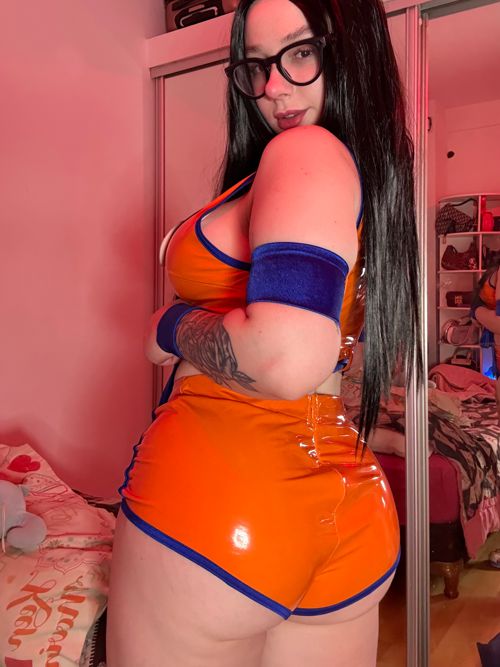
FEATURED MODEL
ONLYFANS · FREE
Foxy Uzumaki
@foxyuzumaki
Discover her photos, explore her content and access her profile for free.

RECOMMENDED SITES
 Add your site
- BoobieBlog
- celeb-stalker.com
- The Nip Slip
- Erosberry
- Shocking Porn
- Kanoni Net
- Candid Teens
- Babes & Bitches
- sweetlicious
Add your site💩 CrazyShit
🤪 eFukt
👉🍑 Top XXX Pictures
Bingo Porno
Best Porn Blog Sites
 Sex Games
MrPornGeek
Hardcore Porn Videos
NSFW.Tools
Sex AI Chat
ShareAnyNudes
Teenager365
Best JAV Models
Hotness
HornyFap
Best AI Porn Generation





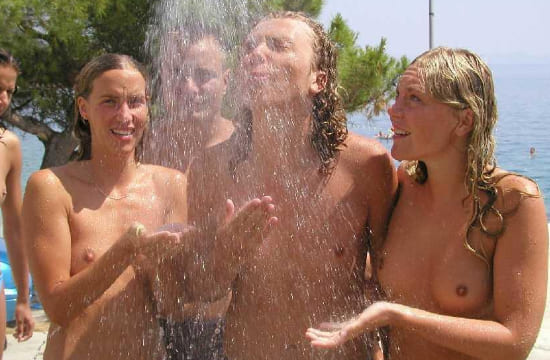





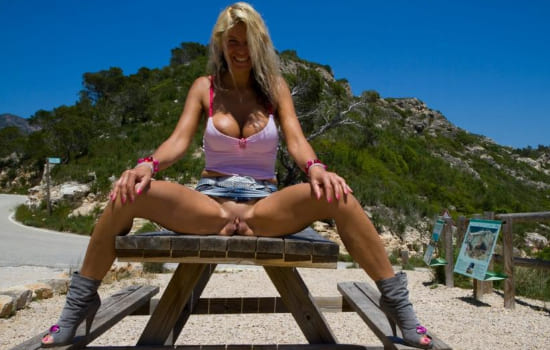
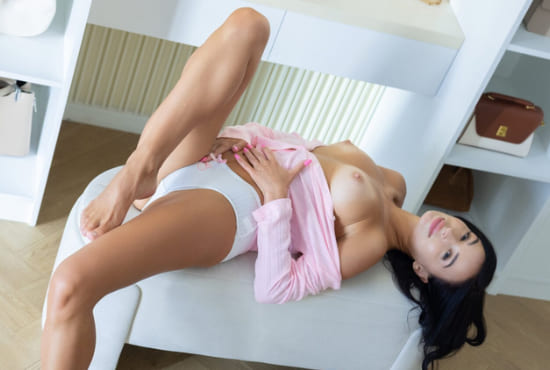
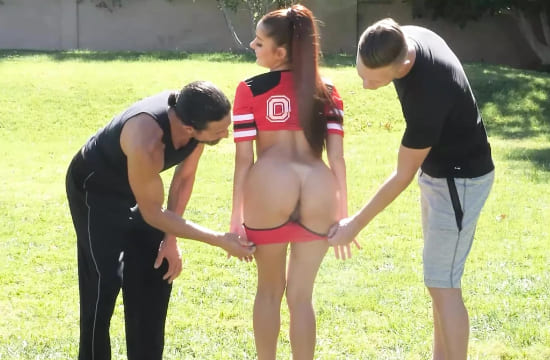


NUDO CAFFE. FIRST INSTALLMENT
Nudo Caffè, known on social media as @grigorianphoto, is a photographer mainly focused on artistic nude and female photography. His work has a natural, intimate aesthetic, where light, textures and the presence of the model herself carry far more weight than any kind of artifice.
His photographs show a clear influence from analog photography: grain, black and white, soft colors and that slightly imperfect look that gives many of his shoots a cinematic feel.
Over the past few years, he has been alternating between analog and digital photography, experimenting with both techniques without losing that distinctive style.
And since going through his work we came across a lot more material than we expected, we've decided to split our selection into two installments. Here's the first one today. More tomorrow.

# View photos
ExtraBall
Fatality.
ExtraBall2




INSTAGRAM OF THE DAY: ARIANAPOPP
Ari Pop🍭
20
University of Arizona

# View photos
You can also follow us on our new INSTAGRAM ACCOUNT
ExtraBall
The balloon game
ExtraBall2







Contact
You can tell us whatever you want via email: [email protected]
If you prefer, you can use this contact form:
If you prefer, you can use this contact form:

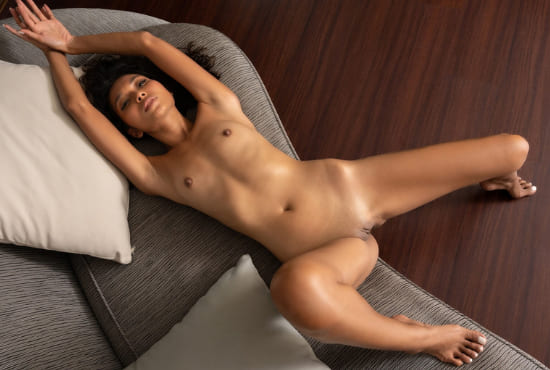
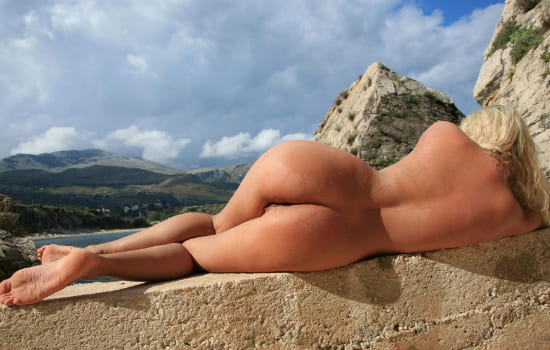
AMATEUR FLESH: COCO
Just two days ago, our next protagonist decided to take a step that had probably been on her mind for quite some time: creating a Reddit account and posting her first nude photos.
Before doing so, she probably spent a long time watching from the other side of the screen. Browsing through other women's profiles, reading people's comments and imagining what it might be like to take that place herself one day. Watching, learning and feeling torn between the desire to do it and the fear of regretting it afterward.
Yes, no. Maybe today, perhaps tomorrow. One photo, none at all, or maybe a few. Weighing up the pros, the cons and that inevitable sense of vertigo that must come from knowing that, as soon as you hit the publish button, a group of complete strangers will be able to see you in a way that, until then, had been reserved for only a privileged few.
Eventually, she made up her mind. She created the account, uploaded her first photos and crossed that little boundary separating those who watch from those who have decided to become the protagonists.
They say the sky is filled with millions of stars. Today, you have just witnessed the birth of a new one.

# View the photos
ExtraBall


BLUE VOL4
Yesterday we were talking about green and our particular way of dealing with the enormous complexity of the color spectrum: if it looks green, it's green.
Today we're switching folders and moving on to blue. And we could do exactly the same thing here. We could talk about sky blue, navy blue, electric blue, turquoise blue, petrol blue, cobalt blue, baby blue... but after yesterday's post, I think we've made our position on subtle shades pretty damn clear.
It's blue.
The funny thing is that blue is usually sold to us as the color of calm, tranquility and serenity. A clear blue sky, a calm sea, a crystal-clear swimming pool... All very relaxing, very zen, very much about taking a deep breath and finding your inner peace.
But then you take that very same blue and turn it into lingerie, a bikini, a tight dress or any other strategically placed piece of clothing, and that whole theory about tranquility starts falling apart pretty quickly.
Because colors, like so many other things in life, depend a lot on where you put them.
And considering where the blues featured in this post have been placed, I'm afraid we're not going to learn much about color psychology today either.
But that's not really what we came here for anyway.

# Watch videos
 You can find much more content like this on our TELEGRAM CHANNEL
How to unlock adult content on Telegram (Apple, Android, or any other device)
If you enter our channel and see an adult-content warning that prevents you from viewing anything, it means the restriction filter is enabled.
Go to https://web.telegram.org, log in, and open:
Settings → Privacy → Sensitive Content
Enable “Disable Restrictions� and you're all set.
The change will automatically sync with the Telegram app on all your devices.
ExtraBall