Eporner HD Sex Porn Discounts Sex Games Porn Games XXX Games Hentai Games PornStar Games 3D Porn Celebrity Sex Videos Free Porn Games
Live Sex Free Live Sex Free Sex Games Páginas Porno Nude Celebrities TikTok Porn Sex Cam Rose Toy Cams Porno AI Porn Videos
Live Sex Free Live Sex Free Sex Games Páginas Porno Nude Celebrities TikTok Porn Sex Cam Rose Toy Cams Porno AI Porn Videos

Published on 2026/01/13
His work is defined by the use of natural models, precise poses, and minimalist settings that highlight the form and the harmony of the body.


THE EROTICISM OF ERIC BURKHANAEV
The artistic nude in Erik Burjanaev's work stands out for its visual approach, creating images that feel closer to painting or sculpture than to traditional photography.His work is defined by the use of natural models, precise poses, and minimalist settings that highlight the form and the harmony of the body.



FEATURED MODEL
ONLYFANS · FREE
Foxy Uzumaki
@foxyuzumaki
Discover her photos, explore her content and visit her profile for free.

FEATURED MODEL
ONLYFANS · FREE
Cocoa Hazel Fantasies
@ebo_goddessvip
Discover her photos, explore her content and visit her profile for free.





 35photo.pro/burhanaev
BolaExtra
When the supermarket is about to close, but life still feels wonderful.
ExtraBall2
(Clicking on these links daily you support ALRNCN's work. They're collaborators or sponsors and, by visiting their sites, they like us even more)










MARIO BROS. MORE THAN 40 YEARS OF JUMPING
The story of Mario begins in 1981, when Nintendo released Donkey Kong, an arcade game designed by Shigeru Miyamoto in which a small character had to dodge obstacles and jump over barrels to rescue a woman kidnapped by a giant gorilla.

Back then, he wasn't even called Mario. He was simply known as Jumpman, and much of his appearance was born out of the huge graphical limitations of the time. With so few pixels available, Miyamoto had to come up with simple solutions to make that tiny character instantly recognizable.
The cap meant they didn't have to properly draw and animate his hair. The mustache helped separate his nose from the rest of his face without having to draw a detailed mouth, while the overalls made it easier to visually distinguish his arms from his body when the character moved.
What we instantly recognize today as Mario was, to a large extent, a collection of practical solutions to technical problems.
The name came shortly afterward. Nintendo of America began calling the character Mario after Mario Segale, the landlord of the warehouse the company rented in the United States.
In 1983 came Mario Bros., where he shared the spotlight with his brother Luigi and his profession as a plumber was firmly established. But the real leap forward came two years later.
In 1985, Nintendo released Super Mario Bros. for the Famicom and Nintendo Entertainment System. Mario began running through huge levels, traveling through pipes, hitting blocks, collecting coins and facing Bowser to rescue Princess Peach.
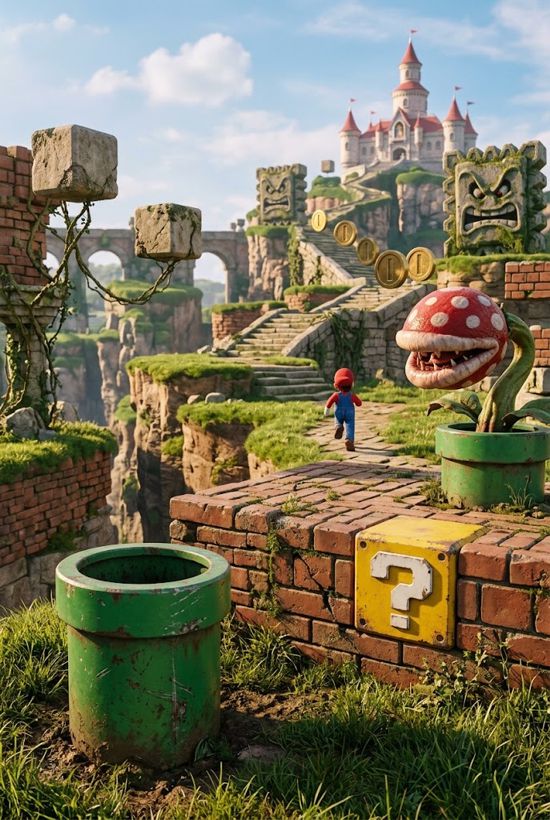
The game went on to become one of the most important and influential titles in video game history, selling more than 40 million copies.
From there came Super Mario Bros. 2, Super Mario Bros. 3, Super Mario World, Super Mario 64, Super Mario Sunshine, Super Mario Galaxy, Super Mario Odyssey and dozens more. Mario also started racing karts, playing tennis, golf and soccer, competing in the Olympic Games, throwing parties and taking on pretty much every profession Nintendo could imagine.
Over the decades, the Mario franchise has sold hundreds of millions of video games, and its universe has expanded far beyond consoles.
TV shows, toys, clothing, comics, merchandise, theme parks and movies have turned the character into one of the biggest icons in global pop culture.
His image has become so recognizable that you don't even need to have played one of his games to know who he is. A red cap, a mustache, blue overalls and an M are enough.
More than four decades after his first appearance, Mario belongs to that small group of characters that have managed to escape the medium they were originally created for. The internet has adopted him, transformed him, parodied him and reimagined him in pretty much every possible way.
And to think it all started with a handful of pixels jumping over barrels.

# Watch video
ExtraBall







TIK HOT VOL248
TikTok has its rules, its limits and an algorithm making sure nobody shows more than they're supposed to. But of course, what you can post on TikTok and what you do once you leave TikTok are two very different things.
Because many of the girls who rack up followers with dances, cleavage, bikinis and strategically calculated videos also have a version of themselves that's considerably less suitable for general audiences.
And that's exactly where Tik Hot comes in.
We keep the same protagonists, but remove the community guidelines, the algorithm looking over their shoulders and a few inches of fabric along the way.
The result is a new selection of videos where some familiar faces from social media remind us that what they show you on TikTok is often nothing more than the trailer.
The full movie... is right here.

# Watch videos
ExtraBall
Quick reflexes.
ExtraBall2






 CamBB.xxx
We find the best live porn cams across many different cam sites like Streamate, Chaturbate, Cam4 and Stripchat.
 ChatSex.xxx
With Chat Sex you get free sex cams featuring nude cam girls you can chat with for free.

FEATURED MODEL
ONLYFANS · FREE
Kaori Uchiha
@cosplaykaori
Discover her photos, explore her content and access her profile for free.

RECOMMENDED SITES
 Add your site
- BoobieBlog
- celeb-stalker.com
- The Nip Slip
- Erosberry
- Shocking Porn
- Kanoni Net
- Candid Teens
- Babes & Bitches
- sweetlicious
Add your site💩 CrazyShit
🤪 eFukt
👉🍑 Top XXX Pictures
Bingo Porno
Best Porn Blog Sites
 Sex Games
MrPornGeek
Hardcore Porn Videos
NSFW.Tools
Sex AI Chat
ShareAnyNudes
Teenager365
Best JAV Models
Hotness
HornyFap
Best AI Porn Generation


















GREEN, HOW I WANT YOU GREEN VOL4
A while ago, we started a little series called Pink, Fuchsia or Magenta, mainly because we discovered that apparently calling everything that looks pink to us simply “pink” is considered an unacceptable oversimplification of the color spectrum.
Apparently not. It can be pink, fuchsia, magenta, blush pink, bubblegum pink, dusty pink... and probably another fifteen shades that someone could distinguish by placing them side by side while we nod along pretending we can see the difference.
Well, exactly the same thing happens with green.
There's olive green, bottle green, emerald green, mint green, pistachio green, lime green, forest green, military green, jade green, moss green... and probably another forty shades of green whose names I don't know and have absolutely no intention of learning.
At ALRNCN, we're simple people. So if it looks green, it's green.
We're not going to waste valuable time trying to decide whether a woman's bra is emerald green with hints of jade or forest green leaning toward bottle green. We have a responsibility to our readers, and there are matters that require our attention far more urgently.
So while color experts can happily argue about shades, saturation and nuances, we'll continue a series based on a much more efficient color classification system:
GREEN, HOW I WANT YOU GREEN.
And inside you'll find women wearing green clothes. Not many of them.
We really don't need to know much more.

# Watch videos
 You can find much more content like this on our TELEGRAM CHANNEL
How to unlock adult content on Telegram (Apple, Android, or any other device)
If you enter our channel and see an adult-content warning that prevents you from viewing anything, it means the restriction filter is enabled.
Go to https://web.telegram.org, log in, and open:
Settings → Privacy → Sensitive Content
Enable “Disable Restrictions” and you're all set.
The change will automatically sync with the Telegram app on all your devices.
ExtraBall







LINGERIE SPECIAL #18
The last installment of our beloved lingerie series was volume 17, published back in December of last year. Nearly nine months have passed since then. That might mean absolutely nothing to you, but I find it pretty interesting.
Throughout all this time, we've published new content every day, Monday through Friday, hardly ever missing our usual appointment. Photos, videos, amateurs, artists, technology, wipeouts, tits, curiosities, and all kinds of material that have made their way onto the front page.
The surprising thing is that, during all these months, we haven't published a single post dedicated exclusively to lingerie. And yet, not once have I looked at the pending folder and thought, “Holy shit, I have nothing to post tomorrow.”
Quite the opposite, in fact. So much varied content has kept coming in that one of the site's longest-running series has spent nine months forgotten in a drawer without anyone having to declare a national emergency.
But nine months is already far too long, especially when we're talking about lace, sheer fabric, garter belts, and the kind of underwear designed to stay on for considerably less time than it takes to choose it.
Today, we're bringing back one of ALRNCN's most beloved collections. Lingerie, volume 18.

# Watch videos
You can find much more content like this on our TELEGRAM CHANNELHow to unlock adult content on Telegram (Apple, Android, or any other device)
If you enter our channel and see an adult-content warning that prevents you from viewing anything, it means the restriction filter is enabled.
Go to https://web.telegram.org, log in, and open:
Settings → Privacy → Sensitive Content
Enable “Disable Restrictions” and you're all set.
The change will automatically sync with the Telegram app on all your devices.
ExtraBall







Contact
You can tell us whatever you want via email: [email protected]
If you prefer, you can use this contact form:
If you prefer, you can use this contact form:




COWS AND THE PROGRESS THEY HAVE BROUGHT TO HUMANITY. VOLUME 3
For thousands of years, our ancestors basically lived off whatever they could hunt, fish, or gather. Until, at some point, someone must have looked at certain animals and thought that maybe it was a hell of a lot more practical to keep the food close to home than spend all day chasing it through the wilderness.
The domestication of animals and the development of livestock farming were among those changes that may seem simple from our modern perspective, but helped completely transform the way early societies were organized.
It was no longer just about getting meat. Animals could provide milk, hides, power to work the land, transportation, fertilizer, and could even become a form of wealth. Owning livestock meant having resources that could be maintained, reproduced, and traded.
And among all those animals, cattle eventually came to occupy a particularly important place. For centuries, cows have fed entire populations, helped people work the land, supported rural economies, and accompanied humans throughout practically the entire development of civilization.
It's curious to think that something as ordinary as a glass of milk, a piece of cheese, or a steak has behind it thousands of years of coexistence between our species and an animal that ended up becoming one of the great silent protagonists of our history.
Generation after generation, humanity kept finding new ways to make use of everything a cow could provide: Meat. Milk. Leather. Labor. Fertilizer.
And just when it seemed that, after all those thousands of years, we had finally explored absolutely every possibility... the 21st century decided to prove that we still had some imagination left.

# Watch videos
You can find much more content like this on our TELEGRAM CHANNEL How to unlock adult content on Telegram (Apple, Android, or any other device)
If you enter our channel and see an adult-content warning that prevents you from viewing anything, it means the restriction filter is enabled.
Go to https://web.telegram.org, log in, and open:
Settings → Privacy → Sensitive Content
Enable “Disable Restrictions” and you're all set.
The change will automatically sync with the Telegram app on all your devices.
ExtraBall


THE INSTAGRAM OF THE DAY: BARMAIDRUBY
BAR MAID❌
bartender & a model 🖤🖤

# View the photos
You can also follow us on our INSTAGRAM ACCOUNT
ExtraBall
#beach #summer #friends #girls #couples

ExtraBall2