How AI is Changing Nude and Erotic Photography In 2026
Just a few years back, artificial intelligence was considered a novelty, and today, it has evolved way past that, as it can be easily considered a real force that is reshaping visual media of various sorts, including nude and erotic photography.
Few technologies have moved as fast or provoked as many arguments as generative AI. In just a few years, the tech evolved from producing warped images that made no sense to photorealistic people who have never existed, retouching real photographs in seconds, and even creating real conversations that can fool the person on the other end into thinking they are talking to a human. Nude and erotic photography, which is a field that has always been the perfect middle between art, technology, and, in a way, business, is being reshaped all at once by AI.
This is a topic that often causes both hype and panic, with a lot of questions being asked and explanations being demanded. Here, we are going to cover what AI is actually doing to erotic photography in 2026, from artificial intelligence models earning real money to deepfake crises forcing lawmakers into action, as well as some uses of AI that people might not have noticed yet.
The Rise Of AI-Generated Models And Imagery
The most visible change is the emergence of entirely synthetic models, generated by AI. These are not photographs of real people, but AI characters with fake names, personalities, backstories, and social media accounts who build real fanbases and earn real money. A few years back, the people who ran these accounts probably started it out as a joke, but today, this is far from it, as it has become a whole part of the industry.
The numbers are quite incredible. According to various sources such as SNS Insider, Coherent Market Insights, and the SQ Magazine, the virtual influencer market, worth around six billion dollars in 2024, has roughly doubled to twelve billion in 2026. By the 2030s, the predictions are that the industry is going to be worth over a hundred billion dollars. Individual AI personalities are some of the best earners, as the best-known ones earn tens of thousands of dollars every month, while the top creators earn a lot more as they route fans from free Instagram accounts toward paid subscription platforms like OnlyFans and Fansly in the same way that human creators tend to do.
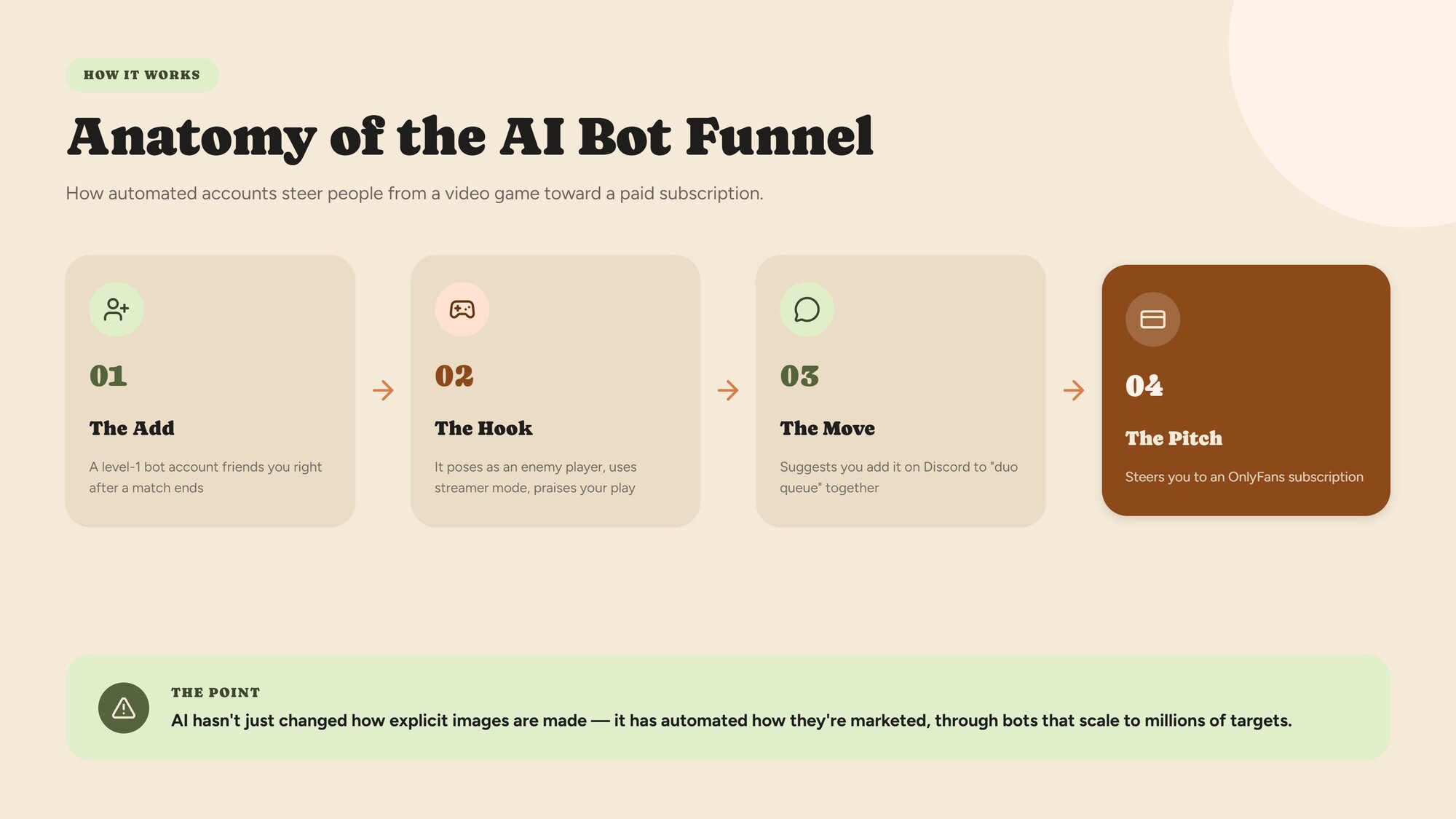
Sources: HypeAuditor, Influencer Marketing Factory, industry earnings trackers (2026)
What makes these figures possible is a combination that brands find difficult to resist. AI models never age, never tire, never cause a scandal, and they can be easily adjusted to fit any kind of campaign that would do best at the time. It may come as a surprise to many, but the engagement of these AI models is about three times higher when compared to real influencers. This could be because they are a novelty in the genre, but it is still an interesting statistic covered by Ann Friedman at CallYourGirlfriend.
Of course, because AI models are becoming so popular, there is a huge wave of AI models appearing on all kinds of platforms, both free and paid. They offer photosets and chat that are completely AI-generated, while feeling completely real, as modern AI models can create images that have believable lighting, skin texture, anatomy, and some of them can be really hard to tell from a real photograph. Still, the technology is not perfect, and upon closer inspection, AI flaws can still be easily noticed, especially when observing more of them at the same time. However, the time when telling a real photo from a generated one is close, which is something worth keeping in mind.
AI As A Tool, Not Just A Replacement
Looking at AI as a replacement for human work is not the right way to do it. For many working photographers and studios, it has simply become a part of their everyday tool kit, as they use AI to handle tasks that would take hours of labor.
One of the best examples is retouching, as this once required a skilled specialist to spend an entire afternoon in Photoshop, while today, it is something that can be done in seconds. From evening skin tones to removing stray distractions in the background, AI is extremely good at doing retouching, especially when used by someone who already has an eye and the skill set in this department beforehand.
Upscaling tools are also a good example, as they can take an older, low-resolution set and bring it up to modern standards without a reshoot, giving new fans to something that would have been lost to time due to its low-resolution nature. There are also AI-assisted lighting and color grading tools that let a photographer test dozens of moods on a single frame before they fully commit to it, and some studios are also using generative tools to create concepts before they book locations or decide on the wardrobe.
The important distinction here is between AI-assisted and AI-generated. An AI-assisted image still begins with a real model, a real photographer, and a real moment where the technology just helps refine things that actually happened. On the other hand, an AI-generated image has no such origin.
The Authenticity Question
There is a paradox that the whole AI situation has created, especially in the world of erotic photography. The more perfectly the technology can fake everything, the more valuable real authenticity becomes. When any image can be generated to flawless specifications, that same flawlessness is no longer that impressive. Everything just looks the same, which is one of the bigger problems with generative AI in the world of photography right now, including the AI models that have been mentioned in the section before.
An AI model with perfect proportions and perfect skin is just another image through an infinite amount of content that a viewer can scroll through, which quickly becomes obsolete and monotone. AI cannot manufacture the sense of a real person, like their smile, unrehearsed moment in front of the camera, and the specific kind of imperfect beauty that an actual human being has in front of the camera.
This is why a meaningful part of the audience is moving away from this technology, towards realness, personality, and the girl-next-door authenticity that AI cannot replicate. The knowledge that a real person exists behind an image, with her own story, preferences, and presence, is what makes erotic photography so compelling in the first place, which is why here at Erotic Beauties, we feature only real models that the technology will never be able to fake.
The Economic Impact On Real Models and Creators
For real models who are making their living in this industry, the rise of AI competition has raised quite a concern, and it would be dishonest to pretend otherwise. When an AI model can produce unlimited content at a near-zero marginal cost, never needing a day off, and without any personal risk, it directly competes with real creators for attention and paid subscriptions.
The effect is uneven, as at the very top, models with big followings and personal brands do not have to worry about this, because their audience is there for them specifically. However, when it comes to the middle and lower entry level of models, this is where the work becomes more interchangeable, and AI alternatives which are cheaper to produce and promote definitely put certain creators at risk.
At the end of the day, the most likely outcome is not wholesale replacement but a split market. A high-volume, low-cost tier of AI content is going to emerge, but when it comes to the premium tier, where the value lies in the real person behind the photos, that will never be replaced. Still, the economics of the industry are going to take a big shift, and only with time, depending on which tier grows faster, will it be the main shaping factor.
Consent, Deepfakes, And The Dark Side Of AI
Everything above concerns consenting adults in legitimate business. The darkest application of AI involves neither, and it is the single most important issue when it comes to this topic, as the same generators that can produce a fictional AI model can also place a real person's face onto an explicit image or video they never participated in.
These non-consensual intimate deepfakes overwhelmingly target women, and the technology has made them, unfortunately, extremely easy to produce. While the issue is different for performers like Mia Malkova, Little Caprice, or Lorena Garcia and others who have already worked in explicit media, the real harm falls on people who are placed into such scenes without any consent.
Back in the day, this once required real skill, but today, all it takes is a cheap app and a few photographs pulled from someone's public social media. The harm to reputation, relationships, and mental health is severe, and it all falls on the victim who did nothing but exist online.
This is not a hypothetical problem. It is something that has driven lawsuits against major AI platforms, and it prompted actions from dozens of state attorneys general. It has become the primary reason lawmakers who move slowly on almost everything technological have moved quickly this time around, and it is the clearest example of AI's capacity for real harm in this field, which is why it should be treated seriously.
The Legal And Regulatory Response In 2026
The law, which is often criticized because it is behind on technology, has moved unusually fast when it comes to non-consensual explicit deepfakes. As of 2026, the landscape is a lot different than it was back in 2024.
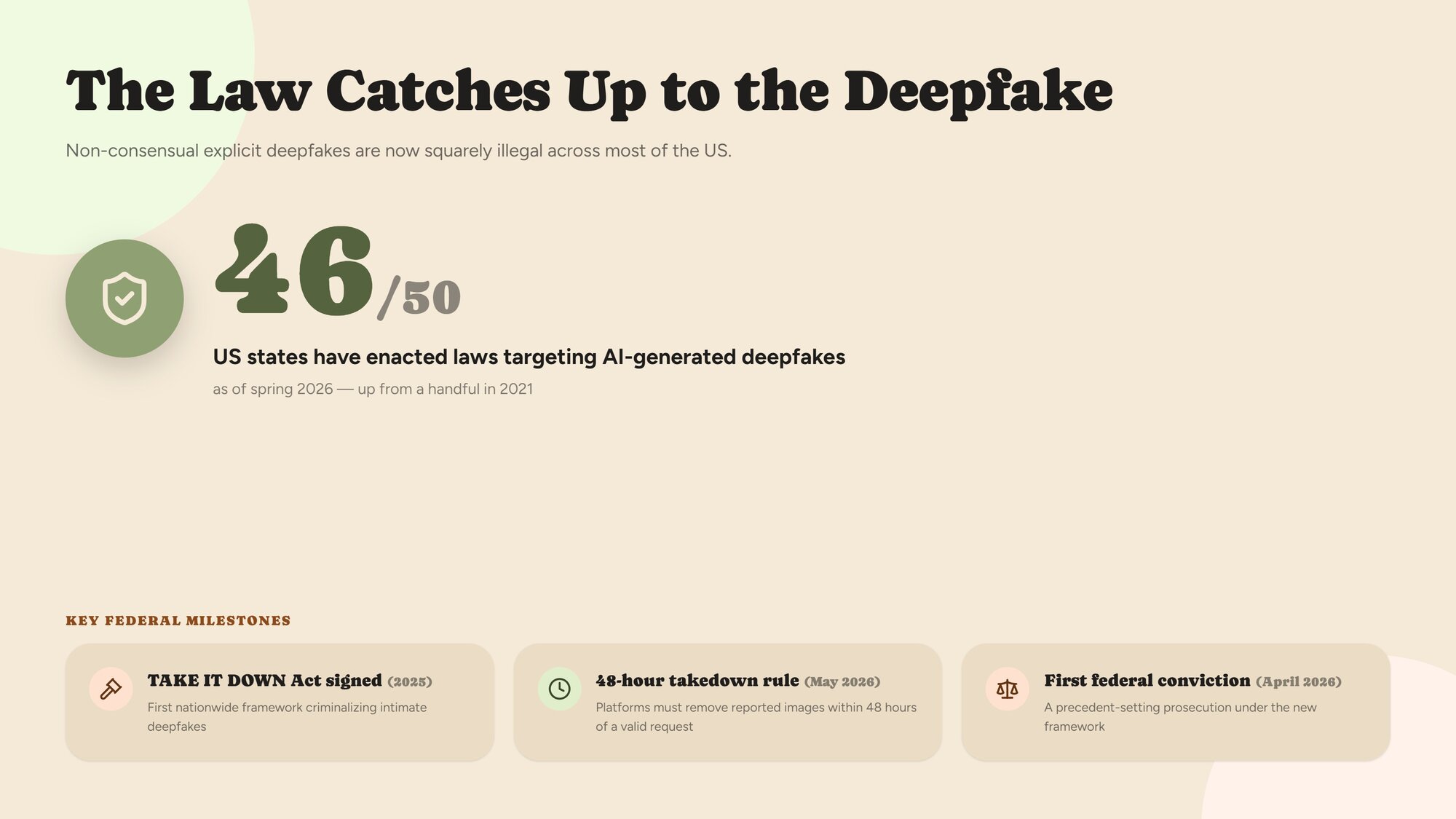
Source: Multistate
At the federal level in the United States, the TAKE IT DOWN Act, signed in 2025, created the first nationwide framework criminalizing intimate deepfakes and requiring platforms to remove reported images quickly. As of May 2026, covered platforms must take down flagged non-consensual imagery within 48 hours of a valid request, and the first federal conviction under the new law came in April 2026.
At the state level, the great majority of US states now have statutes on the books targeting AI-generated explicit imagery, most built by amending existing laws against non-consensual pornography. For those who would like more information on this, Nolo and Criminal Defense Lawyer have covered this topic in much deeper detail.
AI Bots And The Automation Of Adult Promotion
While many might be familiar with the concepts beforehand, there is a dimension to this story that most coverage misses entirely. AI has not only changed how erotic images are made, but it also transformed how they are marketed, and some of the most inventive and deceptive uses of the technology are in promotion rather than production.
The mechanism is in automation. AI-powered bots and fake accounts can now run the kind of personalized outreach that once required a human, at a scale no human could match. Nowhere is this clearer than in a scheme that has spread through online gaming, and a recent example from the game League of Legends shows this perfectly.
This is how it works. Players queue up for a game, and shortly after the match ends, a freshly-made, level-1 account adds you as a friend. It presents itself as someone who was in the same game using streamer mode, so its real identity is conveniently hidden, and it opens the conversation with flattery, telling you that you played well. It then suggests adding it on Discord (a popular free communication app, especially among gamers, that lets people talk via text, voice, and video) so you can play together in the future. After agreeing to do so, the friendly fellow player reveals its actual purpose, which is to steer you toward someone's paid subscription, in most cases on OnlyFans. The catch - the "player" was never a player at all!
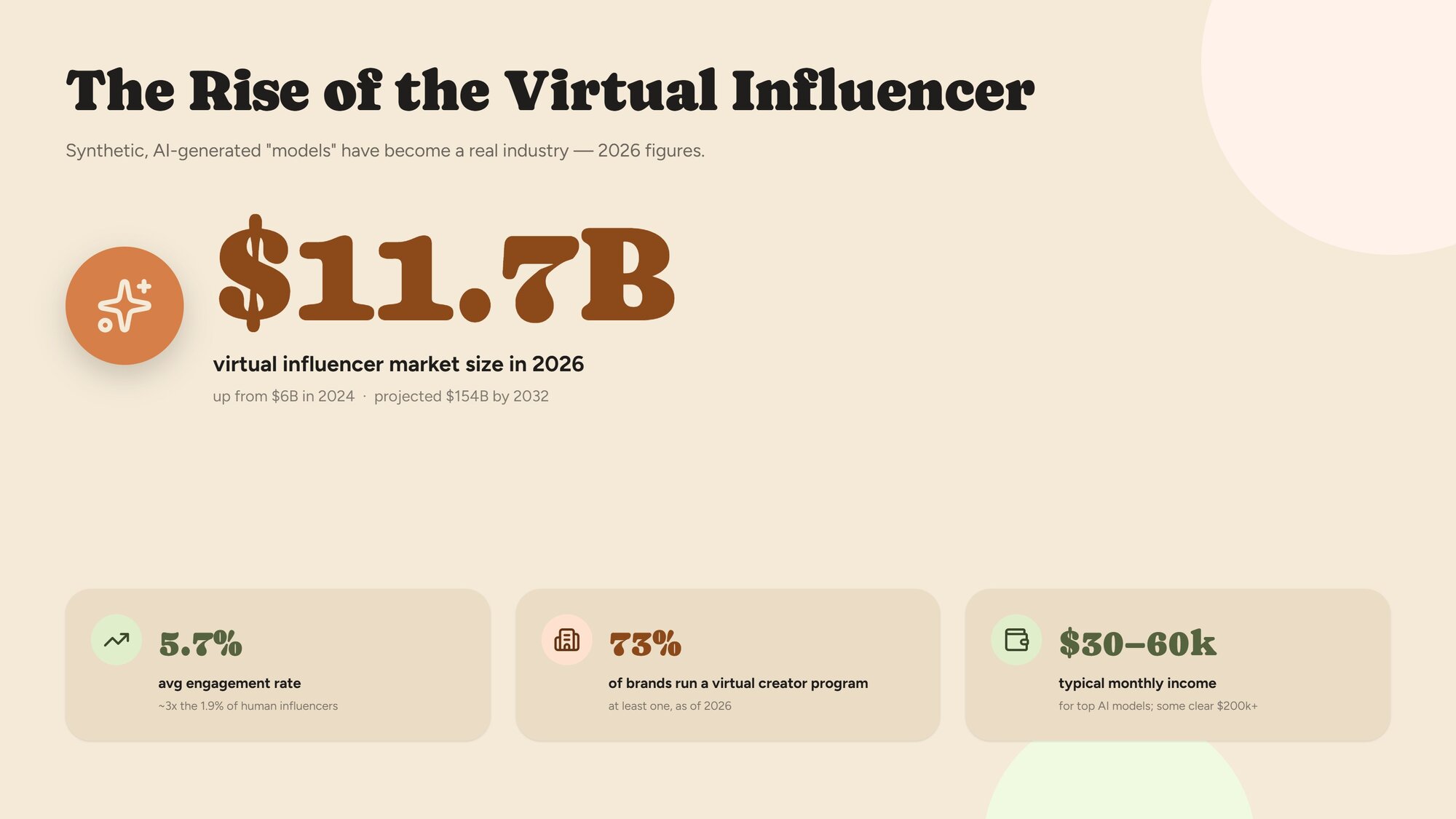
What makes this an AI story rather than just an old-fashioned scam is the automation behind it. The friend request, the tailored compliment, the conversational back-and-forth - all of these steps can be scripted and run by bots across thousands or millions of targets at the same time! The same basic funnel appears on social platforms and dating apps, and it is becoming more convincing as the conversational AI behind it improves. It is a good reminder that the disruption is not confined to image generation itself, but that there is an entire pipeline from creation to discovery to the pitch, fully automated without being honest about it.
What This Means For The Future Of Erotic Photography
When all of this is put together, you will get a picture that is not the utopia where technology brings salvation nor the apocalypse that a lot of critics are afraid of. Instead, the future ahead is most likely going to be a divided one. On one side, expect a growing volume of pure AI content, including AI models, AI-generated sets, AI-run promotion, and a lot of it, for low cost. On the other hand, you can also expect renewed and rising premium on real human content, with real models, real photographers, real moments, who are valued exactly because they are the one thing that cannot be generated, like all of the models featured here on Erotic Beauties.
Rather than replacing the other, the two are most likely going to pull apart into distinct markets serving specific desires. The serious harms, such as non-consensual deepfakes, will remain a defining ethical challenge, and the legal and technical response to them will always have to keep evolving. However, for legitimate erotic photography built on consenting, real people, the arrival of AI may end up clarifying their value rather than erasing it.
The Real Thing Still Matters
Artificial intelligence has changed the tools of erotic photography, and it will keep changing them. It can generate flawless images of a person who does not exist, retouch a real one beyond recognition, and run the entire marketing operation behind. Still, what it cannot do is be a real person, and that turns out to be what matters most. When perfection is free and infinite, being unique is a luxury, and if anything, the world filling up with fabrications has never been more valuable for real human creators in the world of erotic photography.


Comments (1)